Nigeria’s livestock sector quietly contributes 17% to our agricultural GDP, yet many farmers still struggle with climate challenges, rising feed costs, and limited market access. What if there was a way to build a profitable livestock enterprise that actually thrives in our diverse agro-ecological zones while supporting local communities? The answer lies in understanding which indigenous breeds outperform expensive imports, and why a West African Dwarf goat might be your most valuable investment.
The path to successful livestock farming in Nigeria isn’t about copying foreign models—it’s about working with our unique strengths. From converting cassava waste into high-quality feed that cuts costs by 40%, to building housing that keeps animals comfortable in both humid southern forests and dry northern plains, smart farmers are discovering opportunities hidden in plain sight. But which climate-smart species should you choose for your specific region, and how do you navigate land acquisition in today’s complex environment?
Selecting Climate-Smart Livestock Species for Nigerian Conditions
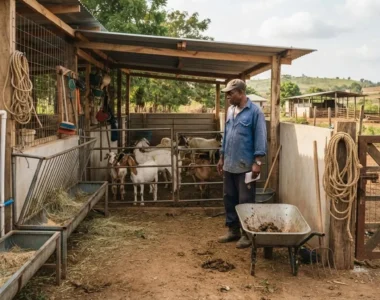
Indigenous breeds consistently outperform exotic imports across Nigeria’s diverse agro-ecological zones; yet, many farmers continue to invest in costly foreign genetics that struggle with local conditions. West African Dwarf (WAD) goats demonstrate superior adaptation to the humid forest zones of southern Nigeria, maintaining productivity levels that imported breeds cannot match during peak humidity periods. These compact animals require 60% less feed than larger exotic breeds while producing milk with higher butterfat content, making them economically superior for smallholder operations.
The trypanosomiasis resistance found in Muturu cattle represents a genetic advantage worth millions in veterinary savings across tsetse fly-infested regions. While Holstein Friesian cattle require constant medication and often succumb to sleeping sickness, Muturu cattle graze freely in affected areas without health complications. This natural resistance, combined with their ability to thrive on poor-quality forage, makes them invaluable for sustainable cattle operations in Nigeria’s middle belt and southern regions.
Multi-species integration creates synergistic relationships that maximize land productivity while reducing input costs. Poultry-fish farming systems utilize chicken droppings as high-protein fish feed, eliminating waste disposal problems while reducing aquaculture feed expenses by 40%. Similarly, goat-crop integration systems allow animals to provide organic fertilizer that increases crop yields by 25-30%, while crop residues serve as supplementary livestock feed during dry seasons.
Regional breed matching requires understanding specific environmental pressures across Nigeria’s ecological zones. Sokoto Red goats excel in northern arid regions due to their heat tolerance and ability to browse on thorny vegetation, while Balami sheep’s larger body size and seasonal breeding patterns align perfectly with middle belt farming systems. The key lies in matching physiological adaptations like coat color, body size, and metabolic efficiency to local climate conditions rather than pursuing uniform breed selection across diverse environments.
Mastering Feed Resource Innovation and Cost Management
High-Quality Cassava Peel (HQCP) technology transforms agricultural waste into valuable livestock feed, addressing both disposal challenges and rising feed costs simultaneously. The fermentation process involves controlled moisture management and specific bacterial cultures that break down anti-nutritional factors while enhancing protein content from 3% to 12%. ILRI’s research demonstrates that HQCP can replace up to 40% of maize in poultry diets without affecting egg production or meat quality, representing potential savings of ₦150,000 per ton compared to conventional feed formulations.
Nigeria’s agricultural system produces approximately 26.5 million tonnes of rice straw and 18.4 million tonnes of maize stover annually, yet most farmers burn these valuable feed resources. Food-feed crop integration maximizes the economic value of every hectare by utilizing grain for human consumption while converting residues into livestock feed. Proper treatment of rice straw through urea-molasses supplementation increases digestibility from 35% to 65%, transforming waste into nutritious fodder that supports year-round livestock production.
“When the Oyo State Governor and our agency, OYSADA, decided to employ and equip over 1000 youths with the necessary skills needed to thrive in any agricultural enterprise of their choosing, we saw ILRI Nigeria as the perfect institute to train youths about the livestock production opportunities that exist around them.” – Dr Debo Akande, Executive Adviser on Agribusinesses to Oyo state Governor and Director-General, Oyo State Agribusiness Development Agency
Seasonal feed planning prevents the boom-bust cycles that devastate livestock productivity during Nigeria’s pronounced dry seasons. Strategic silage production during peak grass growth periods preserves nutrients that would otherwise be lost to weathering and fires. Elephant grass silage, when properly prepared with 30% dry matter content, maintains 85% of its nutritional value for eight months, providing consistent feed quality when natural pastures fail.
Near-Infrared Spectroscopy (NIRS) technology revolutionizes feed formulation by providing instant analysis of nutrient content, moisture levels, and anti-nutritional factors. This rapid testing capability allows farmers to optimize feed mixtures based on actual nutritional values rather than estimated book values, reducing feed costs by 15-20% while improving animal performance through precision nutrition.
Navigating Land Acquisition and Infrastructure Development
Strategic location selection determines long-term farm viability more than any other single factor, particularly given Nigeria’s complex land tenure systems and evolving farmer-herder conflicts. Proximity to year-round water sources reduces infrastructure costs while ensuring livestock survival during extended dry periods. Areas within 5 kilometers of major roads provide market access advantages but require careful consideration of disease transmission risks from livestock movement corridors.
Climate-adaptive housing design addresses Nigeria’s extreme temperature and humidity variations through locally-sourced materials and traditional building techniques enhanced with modern ventilation principles. Southern region livestock housing requires elevated floors and cross-ventilation systems that maintain air movement during humid periods, while northern structures need thermal mass and wind protection during harmattan seasons. Bamboo and palm frond construction materials provide excellent insulation properties at 70% lower cost than imported building materials.
Water resource management extends beyond simple provision to include backup systems and conservation strategies essential for Nigerian farming conditions. Borehole placement requires hydrogeological surveys to avoid seasonal water table fluctuations, while rainwater harvesting systems can provide 60% of annual water needs in areas receiving 800mm+ rainfall. Strategic water storage using locally-manufactured ferro-cement tanks offers cost-effective solutions that withstand Nigeria’s temperature extremes.
Biosecurity infrastructure planning prevents disease outbreaks that can destroy entire livestock enterprises within weeks. Entrance protocols, including footbaths, vehicle disinfection stations, and visitor registration systems, cost less than ₦500,000 to implement but prevent losses worth millions. Quarantine facilities sized at 10% the main herd capacity allow safe integration of new animals while preventing disease transmission to established livestock.
“As an experienced poultry farmer who has tested and adopted the use of HQCP, I am encouraging ILRI to push and get more people to be trained and certified on the processing. I am ready to be an ambassador and tell all poultry farmers that HQCP is a good alternative to Maize and can help reduce the price of poultry products.”
Modular expansion strategies accommodate the gradual scaling typical of Nigerian livestock enterprises, avoiding the capital intensity that limits farm growth. Initial infrastructure designed for 50 animals can expand to 500 without major reconstruction through standardized pen modules and flexible utility systems. This approach reduces initial investment requirements by 60% while maintaining expansion potential as farm revenues grow.
Building Resilient Health Management and Veterinary Networks
Preventive health protocols tailored to Nigeria’s disease patterns provide cost-effective protection against the most common livestock ailments affecting farm profitability. Newcastle disease vaccination schedules aligned with seasonal outbreaks reduce poultry mortality from 40% to less than 5% in properly managed flocks. Trypanosomiasis prevention through strategic grazing management and tsetse fly control measures costs ₦2,000 per animal annually but prevents losses averaging ₦50,000 per infected animal.
Traditional medicine integration combines indigenous knowledge with modern veterinary practices, creating affordable health management systems accessible to smallholder farmers. Neem leaf preparations demonstrate proven efficacy against external parasites while costing 80% less than commercial acaricides. Local veterinary extension services increasingly recognize these traditional approaches, providing training that validates indigenous practices while ensuring proper application methods.
Disease early warning systems rely on behavioral and environmental indicators that allow intervention before clinical symptoms appear. Reduced feed intake, changes in social behavior, and altered movement patterns provide a 48-72 hour warning of health problems when properly recognized. Community health networks facilitate rapid information sharing about disease outbreaks, enabling coordinated responses that prevent widespread livestock losses.
Cooperative veterinary arrangements reduce individual farm costs while improving service quality through bulk purchasing power and shared expertise. Farmer groups negotiating collective veterinary contracts achieve 40% savings on routine services while ensuring rapid response during emergencies. These arrangements also facilitate knowledge transfer between experienced and beginning farmers, strengthening overall community livestock management capabilities.
Record-keeping systems adapted to Nigerian livestock farming conditions balance simplicity with effectiveness, using mobile phone applications and paper backup systems that function regardless of technology access. Vaccination tracking, breeding records, and health incident documentation provide data essential for optimizing farm performance while supporting insurance claims and veterinary consultations. Simple color-coding systems allow illiterate farmers to maintain accurate records through visual identification methods.
Developing Market Access and Value Chain Integration
Direct marketing strategies bypass exploitative middlemen while building customer relationships that support premium pricing for quality livestock products. Urban consumers increasingly seek traceable, naturally-raised meat and dairy products, creating opportunities for farmers who can demonstrate animal welfare and feed quality standards. Weekly market participation builds customer loyalty that supports 20-30% price premiums over commodity livestock sales.
Value addition transforms raw livestock products into higher-margin processed goods that capture more value within farming operations. Milk processing into yogurt and soft cheeses requires minimal equipment investment but doubles product value, while hide processing for leather goods creates additional revenue streams from animals sold for meat. Organic fertilizer production from livestock manure provides a consistent income that complements seasonal livestock sales.
Cooperative marketing models aggregate small-scale production into volumes that attract serious buyers while reducing individual transaction costs. Farmer cooperatives handling 1000+ animals annually negotiate better prices and payment terms than individual farmers selling 10-20 animals. Shared transportation arrangements reduce delivery costs by 60% while ensuring consistent market access regardless of individual farm production levels.
Digital marketing applications connect Nigerian livestock farmers with urban consumers seeking quality animal products through e-commerce platforms like Transville Agro and social media channels. WhatsApp business accounts and Facebook marketplace listings cost nothing to establish but provide access to customers willing to pay premium prices for farm-fresh products. Video documentation of farming practices builds consumer confidence and justifies higher prices for naturally-raised livestock.
Quality certification pathways, including organic certification and halal compliance, open premium market opportunities that reward sustainable farming practices with higher prices. Organic certification requires 2-3 years of documented chemical-free production but enables access to export markets paying 40-50% premiums over conventional livestock products. Seasonal price management through strategic sales timing maximizes profits during high-demand periods like Eid celebrations and Christmas seasons, when livestock prices increase 25-35% above average levels.
Building Your Livestock Legacy: The Path Forward
Nigeria’s livestock farming sector isn’t waiting for perfect conditions—it’s thriving through indigenous wisdom and innovative adaptation. From WAD goats that outperform expensive imports to cassava waste transforming into premium feed, successful farmers are discovering that profitability comes from working with our environment, not against it. The integration of traditional knowledge with modern techniques, strategic breed selection, and community-based marketing networks creates sustainable enterprises that support both farmer prosperity and food security across our diverse agro-ecological zones.
The question isn’t whether livestock farming can succeed in Nigeria—it’s whether you’ll choose to build with our natural advantages or continue struggling against them. Climate-smart species selection, innovative feed management, and cooperative market access aren’t just farming strategies; they’re pathways to agricultural independence that honor our heritage while embracing our future.
The farmers who recognize that our indigenous breeds hold the keys to tomorrow’s prosperity won’t just survive Nigeria’s agricultural transformation—they’ll lead it.
Discover more from Transville Agro
Subscribe to get the latest posts sent to your email.